Colorado adventure travelers know sand dunes better than most. Great Sand Dunes National Park in the San Luis Valley — the tallest dune field in North America at 750 feet — draws hundreds of thousands of visitors every year for sandboarding, hiking, and the particular visual strangeness of a massive dune field sitting against the Sangre de Cristo Mountains. If you have stood on Star Dune at sunset, you understand what makes desert terrain unlike anything else.
Huacachina does the same thing in a completely different way.
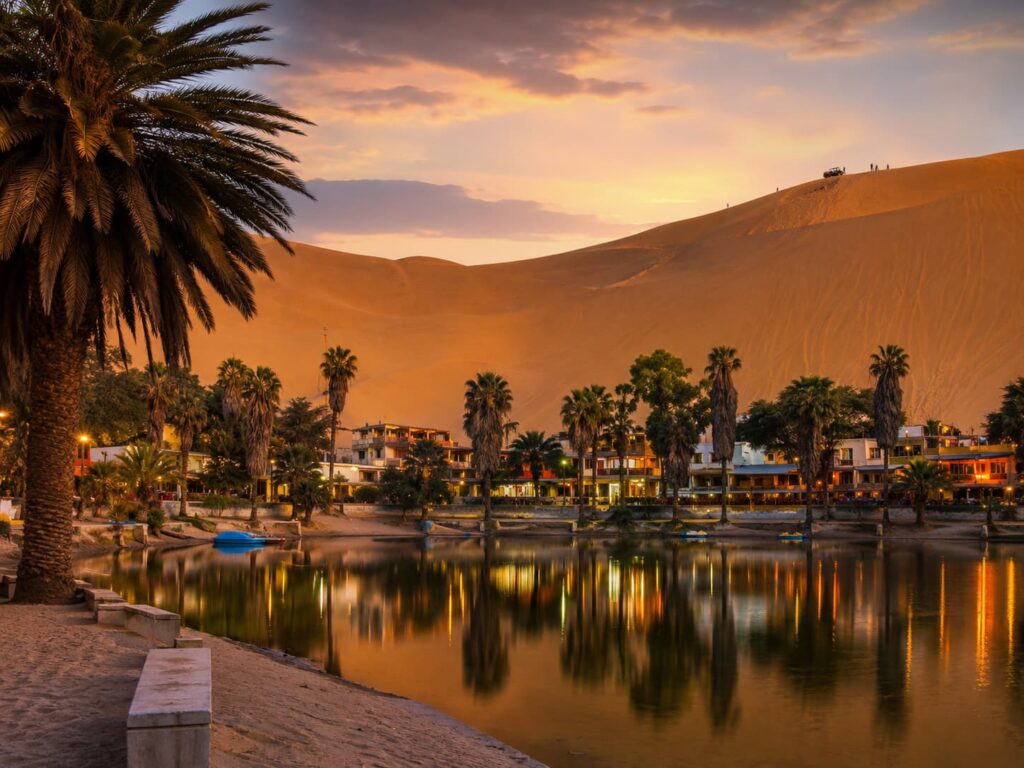
Peru’s only desert oasis sits 300 kilometers south of Lima in the Ica coastal desert — a palm-fringed lagoon completely encircled by dunes that reach 200 meters. It is not a recreation area designed around the dunes. It is a small village that exists entirely because of them, a green circle surrounded by endless sand in a landscape that feels like it should not be real. Colorado adventure travelers who make the trip south consistently arrive with Colorado as their reference point and leave describing something they were not prepared for.
Here is what makes Huacachina worth the flight, and how the experience compares to what Colorado desert travelers already know.
The Dunes: What Makes Huacachina Different
Great Sand Dunes impresses through scale and isolation. The dune field rises sharply from the flat San Luis Valley with no gradual approach — you drive toward what looks like a low ridge and then the scale resolves and it turns out to be something much taller. The tallest dunes require real effort to climb and the views from the top reward that effort with a 360-degree look at a landscape that has no business being where it is.
Huacachina’s dunes operate on a similar visual logic but with different characteristics that matter for the activities they support.
The dune faces around Huacachina are steeper than most Colorado dune terrain. The sand composition — fine, dry, compacted by coastal wind patterns rather than the freshwater sand sheet dynamics that shape Great Sand Dunes — creates slope angles that make sandboarding behave differently than it does in Colorado. At Great Sand Dunes, sandboarding on a wax-treated board in dry conditions is a moderate-speed experience. At Huacachina, the local sand on a polished wooden board produces speeds that riders consistently describe as faster and less controllable than they expected, which is to say exactly as fast and uncontrollable as everyone hopes a dune descent will be.
The dune buggy element is the experience that has no Colorado equivalent. Open-frame four-wheel-drive buggies built specifically for dune terrain carry groups of eight to ten people at speeds that make the dune field feel like a roller coaster. Drivers who have spent years on these specific dunes know every slope and crest. The vehicles climb nearly vertical sand faces at full throttle and drop over the far side into terrain the passengers cannot see until the buggy crests the edge. It is, in the accurate sense of the phrase, an adrenaline activity. It is also the primary reason most people come to Huacachina and the reason most of them book a second tour on the same day they complete the first one.
The Oasis: The Feature That Has No Colorado Equivalent
Great Sand Dunes has Medano Creek, the seasonal stream that runs along the dune base and provides the famous wading experience. It is cool, shallow, and the visual contrast of running water against sand is striking.
Huacachina has a lagoon.
A permanent, palm-fringed, turquoise lagoon sitting in a bowl of 200-meter dunes, with a small village of restaurants and hostels built around its perimeter, visible from the top of every surrounding dune as a green circle in an otherwise entirely sand environment. The oasis exists because freshwater rises to the surface through the desert substrate at this specific geological convergence — the same basic principle behind desert oases everywhere, but visible here at a scale and with a surrounding landscape that turns the concept from a geographical fact into a visual experience.
Seeing Huacachina from the top of a dune during sunset — when the light on the sand has turned golden and the lagoon below reflects the sky — is the moment that Colorado adventure travelers write home about. Not the dune descent. Not the buggy speed. The view from above of something that should not exist, sitting there exactly as described, smaller than expected and more improbable than any photograph suggests.
The Tours: How Huacachina Works in Practice
Unlike Great Sand Dunes, where most visitors arrive independently and manage their own activity, Huacachina’s dune experience is organized around guided tours. This is not a limitation. It is what makes the dune activity accessible to anyone regardless of prior desert experience.
The standard experience is a dune buggy and sandboarding combination tour running two to four hours in the late afternoon. Departure around 4 PM is standard across reputable operators — the afternoon timing is not incidental. Midday desert sun on 200-meter dunes is genuinely punishing. Late afternoon produces the golden hour light that makes the landscape photogenic and reduces the surface temperature of the sand from “damaging” to “warm.” The sunset from the top of the highest dune, reached after ninety minutes of buggy riding and multiple sandboarding runs, is the scheduled final event of every sunset tour.
Huacachina Tours compares verified operators across the full range of Huacachina experiences. The most booked local tour — the Huacachina Sunset Sandboarding and Buggy Adventure at $69 per person — covers 20 kilometers of dune terrain, makes six stops for sandboarding with expert instruction including a snowboardcross-competitor instructor, provides professional photo and video capture of every run, and returns guests to the oasis for the sunset from the dune crest. For travelers already in Huacachina or Ica, this is the benchmark experience.
For Colorado travelers planning to visit Lima and add a Huacachina day, the combination format is the standard approach. The Paracas and Huacachina Premium Day Trip from Lima covers two destinations in one day from hotel pickup: a morning speedboat tour of the Ballestas Islands off Paracas (sea lions, Humboldt penguins, seabirds in quantities that rival the Galapagos at a fraction of the distance) followed by the afternoon dune experience in Huacachina. This tour has over 15,000 documented bookings and a 4.8 rating — the most-booked single-day Peru tour on the platform by a significant margin.
Sandboarding at Huacachina vs. Great Sand Dunes: The Honest Comparison
Colorado sandboarders who have ridden Great Sand Dunes and are considering Huacachina want a direct comparison, so here it is.
Sand characteristics: Great Sand Dunes’ sand is coarser, mixed, and affected by freshwater dynamics that vary by season. In dry conditions with a waxed board, runs are moderate. In wet or wind-affected conditions, sandboarding at Great Sand Dunes can be sluggish. Huacachina’s sand is fine, dry, and consistently composed across the dune field. Board speed at Huacachina is faster across the range of conditions visitors typically encounter.
Slope access: At Great Sand Dunes, riders choose their own lines by hiking to an appropriate slope. There are no guides, no instruction, and no curated starting points. At Huacachina, guides assess each stop and select the line based on conditions, rider experience, and what each person is attempting. Instruction for standing runs is provided by guides, and the snowboardcross instructor on the premium sandboarding tours brings a caliber of technical guidance that is genuinely unusual for a $49 to $69 tour.
Board quality: Great Sand Dunes’ rental boards are fiberglass on metal frame, relatively standard. Huacachina’s local boards are treated wooden boards that have been refined for the local sand characteristics. The premium sandboarding tour offers full professional snowboard-style binding gear with proper stance and edge control that changes what standing runs are capable of.
Infrastructure: Great Sand Dunes is a national park with visitor center, parking, and creek access. Huacachina is a small oasis village where the entire experience is organized around a lagoon you can walk in ten minutes. This is not a comparison of quality — it is a difference in what each place is and what it is optimized for.
The honest assessment: experienced Colorado sandboarders will find Huacachina’s faster sand, steeper lines, and more consistent conditions closer to what they are looking for, while first-time sandboarders will find the guided instruction format at Huacachina more supportive than the self-directed experience at Great Sand Dunes.
Combining Huacachina with the Rest of Southern Peru
Colorado adventure travelers who make the trip to Peru are typically not going only for Huacachina. The geography of Peru’s southern region supports a natural multi-destination itinerary that Huacachina fits into cleanly.
Paracas sits one hour north of Huacachina on the Pacific coast. The Ballestas Islands boat tour from Paracas is one of the strongest wildlife experiences in all of South America below the equator — the islands support sea lion populations, nesting seabirds in numbers that are genuinely overwhelming, and a breeding colony of Humboldt penguins. The Paracas National Reserve extends along the coast and combines red-rock desert terrain meeting the Pacific with exactly the kind of dramatic landscape that Colorado travelers recognize as visually significant.
Ica city, ten minutes from Huacachina, is the center of Peru’s wine and pisco production. The Huacachina Wine and Pisco Tour with Dune Buggy Adventure — available through Huacachina Tours at $47 per person — combines a working pisco distillery visit and wine tasting at a regional cellar with the afternoon dune experience. For travelers who want to understand the Ica region beyond its sand, this is the format that delivers both.
Nazca sits 2.5 hours south of Huacachina and is the departure point for flights over the Nazca Lines — the geoglyphs carved into the desert surface that are visible only from the air. The lines represent one of the enduring mysteries in archaeology, and the flight experience over them is unique in the Americas.
Cusco and Machu Picchu are the most common northern Peru add-on, reachable by domestic flight from Lima. Most travelers combining Huacachina with Cusco do it across a five-to-seven day Peru itinerary, splitting time between the two distinct regions.
The Peru Tourism authority maintains current information on entry requirements, regional access, and sustainable tourism initiatives including those specifically covering the Ica-Huacachina desert region.
Practical Information for Colorado Travelers
Getting there: Lima’s Jorge Chavez International Airport (LIM) is the entry point. Direct flights from Denver International (DEN) connect through Miami, Houston, or Dallas, with total travel time typically 10 to 14 hours depending on layover. From Lima, the standard route to Huacachina is a four-to-five-hour comfortable coach to Ica, then a ten-minute taxi to the oasis. The Lima day trip format — departing from Lima at 5 or 6 AM and returning by midnight — is a legitimate option but produces an exhausting day. One or two nights in Huacachina is the better approach for anyone who wants to experience the dunes at their own pace rather than on a schedule.
Best season: Huacachina’s desert climate is stable year-round, but April through November produces the clearest skies and most comfortable daytime temperatures (20 to 30 degrees Celsius, similar to a Colorado summer). December through March is Peru’s summer and brings heat that can exceed 35 degrees Celsius in the desert. The late afternoon tour timing mitigates midday heat for most visitors regardless of season.
Booking: The standard sunset buggy and sandboarding tour can be booked on arrival in Huacachina through the oasis operators. The premium experiences — the professional sandboarding and video tour, the desert dinner under the stars, the Paracas combination day trips from Lima — book out and require advance reservation. Huacachina Tours provides pre-arrival booking for all premium formats and the Lima day trip options, with verified operators and clear cancellation policies.
What to bring: Colorado outdoor travelers will find the packing list familiar: closed-toe shoes for sandboarding (the foot-dragging braking technique requires grip and coverage that sandals cannot provide), high-SPF sunscreen applied before the tour begins, sunglasses or goggles for the buggy ride at speed, a windproof layer for the descent and the dune crest at sunset, and camera gear secured in a sealed bag or case. Sand at Huacachina is fine enough to find its way into anything not specifically closed against it — Colorado camping and desert hiking gear applies directly.
Why Huacachina Works for Colorado Adventure Travelers Specifically
The outdoor culture of Colorado — the willingness to drive four hours to access terrain, the comfort with altitude and heat, the preference for active experience over passive tourism — translates directly to what Huacachina rewards.
Huacachina is not a destination that suits everyone. It is small, tourist-focused, and there is genuinely limited to do beyond the dune activities and the oasis atmosphere. Travelers looking for cultural immersion, cuisine, or multi-day hiking are better served by Cusco and the Inca Trail. Travelers looking for wildlife are better served by Paracas and the Galapagos.
But for adventure travelers who understand what it means to stand at the top of a dune at sunset after two hours of physical activity and look at a landscape that justifies the trip — Huacachina delivers exactly that, with a different kind of desert terrain than Colorado offers and an oasis at the center that gives the whole landscape a visual anchor unlike anything in the American Southwest.
Colorado’s Great Sand Dunes are worth every visit you can make to them. Huacachina is what you book when you want to understand what sand dunes look like when taken to a different extreme, on a different continent, with a lagoon at the bottom and 200-meter walls rising in every direction.
[For more outdoor adventure coverage, travel guides, and Colorado news, explore the articles on this site.]
About the author: Written by a travel and outdoor adventure writer with experience across South American desert destinations and the US Southwest.