A security alert pops up on a developer’s screen. They stop what they are doing. They investigate. The finding turns out to be nothing. This happens again. And again. Ten times that week. The team starts ignoring the tool altogether.
False positives eat up engineering hours.
Teams spend countless hours triaging issues that lead nowhere. Real vulnerabilities get buried somewhere in the noise.
SonarQube generates a high volume of low-impact findings. The pattern-matching engine flags issues that are not actually exploitable. Teams become desensitized. Alerts get ignored. The tool loses its purpose.
Each platform on this list handles false positives through different methods. Runtime intelligence validates findings in some tools. AI-driven correlation filters noise in others. The goal remains the same – show developers only the vulnerabilities that genuinely matter. For engineering teams tired of chasing phantoms, these SonarQube alternatives offer a way out.
1. Aikido
Aikido combines multiple noise-reduction layers into one system. Reachability analysis checks which functions actually execute in the codebase. AutoTriage validates SAST findings before they reach developers. Contextual prioritization rescales severity based on the environment. The result is an 85-95% reduction in false positives.
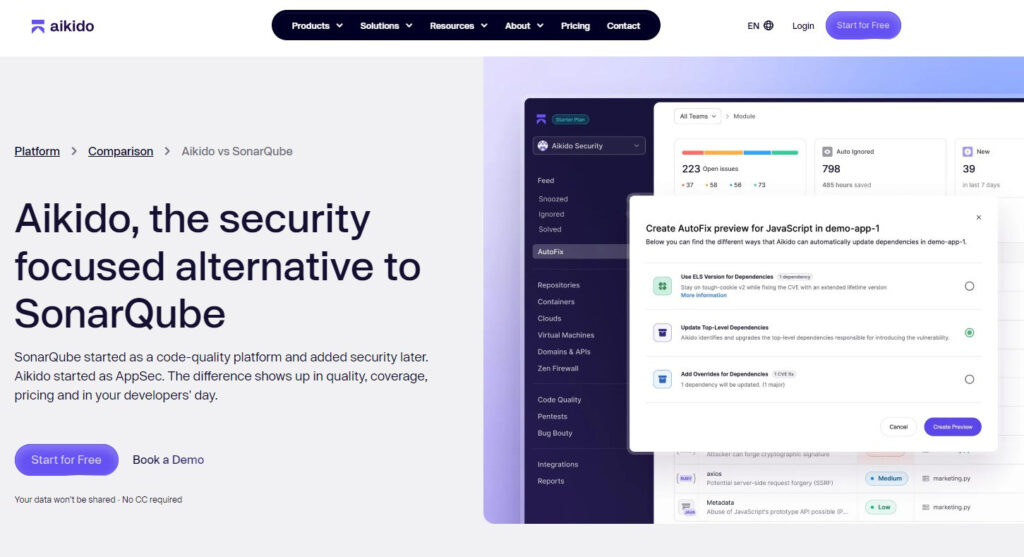
The platform covers SAST, SCA, DAST, secrets detection, container scanning, IaC scanning, and cloud posture management. Each scanner feeds into the same noise-reduction engine. When a vulnerability exists in a dependency but the code never calls it, the alert simply never appears. When SAST flags something, developers can validate it directly in their IDE. The system sends code snippets to an LLM to determine whether a finding is genuinely exploitable.
The platform charges per active developer. Per-line-of-code fees do not apply. Module upcharges never appear on the invoice. The free tier includes two users.
How Aikido eliminates false positives:
- Reachability analysis filters out unreachable vulnerabilities at the source.
- AutoTriage confirms whether SAST findings are actually exploitable.
- Contextual prioritization adjusts severity based on environmental exposure
- All layers work together to reduce noise without sacrificing coverage.
Who this fits: Engineering teams drowning in false positives. Organizations that want a SonarQube alternative focused exclusively on security rather than code quality.
2. Invicti
Invicti brings together the legacies of Netsparker, Acunetix, and Kondukto. The company focuses on proof-based scanning. Every vulnerability gets confirmed before developers see it. The DAST engine delivers 99.98% accuracy. False positives are extremely limited.
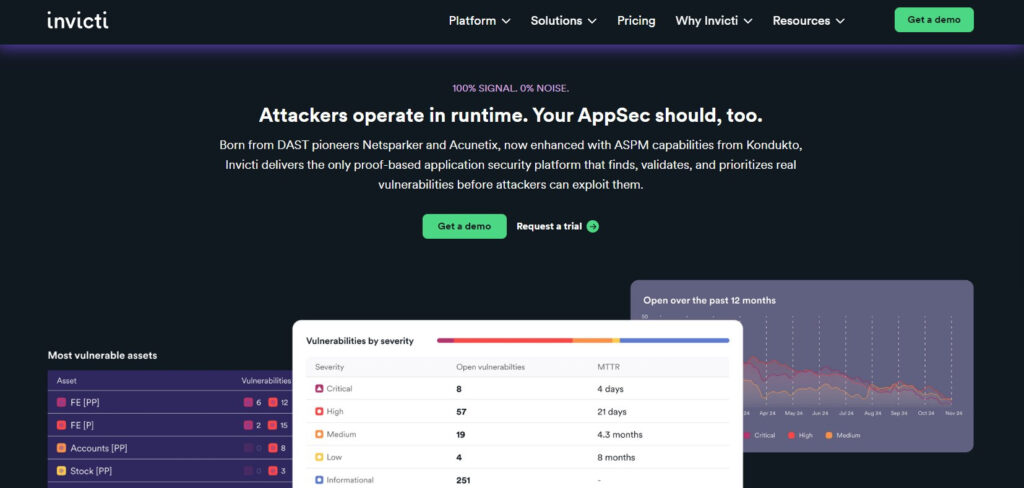
The platform covers DAST, SAST, SCA, API security, secrets scanning, and container security. Runtime intelligence validates results from every testing tool. The system confirms what is real and drives faster fixes through AI and automation.
G2 reviewers mention that Invicti flags vulnerabilities that matter, not a wall of false positives. The platform uses runtime-informed prioritization that cuts through vulnerability noise.
How Invicti reduces false positives:
- Proof-based scanning validates vulnerabilities with 99.98% accuracy. Only confirmed findings surface.
- Runtime intelligence correlates all security testing tool results in a single view. The system prioritizes vulnerabilities by real risk.
- AI-powered remediation guidance shows developers the root cause of each vulnerability. Step-by-step instructions speed up fixes.
Who this fits: Security teams that want proof-based validation before triaging findings. Organizations looking for a SonarQube alternative firm that eliminates guesswork.
3. Snyk
Snyk started with open-source dependency scanning. The company expanded into a full developer security platform. Over 2,500 enterprise customers now use Snyk. Developers rely on it for code scanning, dependency checks, container security, and infrastructure as code.
Snyk’s API and web vulnerability scanner delivers a 0.08% false positive rate. The scanner detects over 30,000 potential vulnerabilities. Only the real ones surface. Snyk AppRisk handles prioritization through risk-based scoring. AI correlates SAST and DAST findings to identify truly reachable risks. The rest never reach the developer.
The platform connects directly to IDEs, Git repositories, and CI/CD pipelines. Findings appear in the developer’s natural workflow. Fix guidance comes built-in.
How Snyk filters false positives:
- AI-driven correlation between SAST and DAST findings surfaces only reachable risks.
- Risk-based scoring prioritizes based on exploitability and production exposure.
- The scanner validates vulnerabilities before surfacing them to developers.
Who this fits: Teams looking for SonarQube alternatives with near-zero false positives. Organizations already using Snyk for SCA that want to expand coverage.
4. Jit
Jit powers its platform with a Company Knowledge Graph that connects code, cloud, policies, and security tools into a single live model. AI agents reason on top of this graph to make grounded security decisions. The company deployed thousands of AI security agents into production across nearly 100 enterprise customers before Torq acquired it in May 2026.
The platform applies reachability analysis to every SCA finding. It builds a call graph that maps relationships between application logic and libraries. If the code can invoke a vulnerable function, the finding gets flagged as reachable. Jit also integrates with Sweet Security to identify which CVEs are actively loaded in application memory during runtime. This separates theoretical vulnerabilities from genuinely exploitable risks. Reachable CVEs automatically increase risk scores and stay at the top of the backlog.
How Jit filters false positives:
- Reachability analysis builds call graphs to trace vulnerable function invocations.
- Runtime insights from Sweet Security flag actively loaded CVEs.
- AI Agents synthesize risk factors and compliance requirements to describe vulnerabilities in plain English.
Who this fits: Organizations needing runtime context to filter false positives. Teams comparing SonarQube alternatives for containers that go beyond static analysis.
5. Qualys
Qualys has been around for over twenty years. The company serves more than 10,000 customers worldwide. Fortune 500 companies are among them. Qualys TruRisk changes how teams look at vulnerabilities. Two scores drive the system.
The Qualys Vulnerability Score (QVS) works at the CVE level. It measures how likely a vulnerability is to be exploited in the wild. The Qualys Detection Score (QDS) takes multiple CVEs and rolls them into one score. Both scores help teams focus on what matters.
Traditional scoring looks at technical severity. That does not tell the whole story. Real-world exploitation is different. Qualys QVS combines traditional metrics with threat intelligence from over 300,000 CVEs. The system pulls data from more than 25 exploit and threat intelligence sources.
How Qualys reduces false positives:
- QVS evaluates vulnerabilities based on CVSS base score, exploit code maturity, and inclusion in the CISA KEV catalog. Active exploitation in the wild gets higher priority.
- QDS consolidates multiple CVEs into one score. The highest QVS among all mapped CVEs determines the QDS value.
- Real-Time Threat Indicators monitor recent exploitation activity across the Dark Web, social media, and GitHub. Trending vulnerabilities receive additional risk elevation.
Who this fits: Organizations needing risk-based vulnerability scoring. Teams comparing top security firm vs SonarQube alternatives with advanced threat intelligence.
Comparison Table
Each platform tackles false positives differently. Aikido uses reachability analysis. Snyk correlates SAST and DAST findings with AI. Invicti validates every vulnerability before developers see it. Jit applies runtime context. Qualys scores based on real-world exploitation data. The table below shows how they compare.
| Platform | False Positive Reduction Method | Key Metric | Noise Reduction Feature |
| Aikido | Reachability analysis + AutoTriage + Contextual prioritization | 85-95% reduction | Swiss cheese layered approach -10 |
| Invicti | Proof-based scanning + Runtime intelligence | 99.98% accuracy -12 | Proof-based validation |
| Snyk | AI-driven SAST-DAST correlation + Runtime validation | 0.08% false positive rate -4 | Near-zero false positives |
| Jit | Runtime-powered CVE loading + AI context graph | Less than 3% false positives -14 | Runtime visibility filters |
| Qualys | QVS + QDS risk scoring + Real-Time Threat Indicators | Prioritizes 70+ QDS scores -6 | Exploit likelihood scoring |
The approaches vary significantly. Pre-deployment validation works for some teams. Runtime intelligence fits others. Risk scoring serves a different purpose. Understanding these differences helps teams pick the right fit.
Frequently Asked Questions
Engineering teams evaluating these platforms often ask the same questions. The answers usually determine which tool makes the final cut. Here are the most common ones.
Which platform has the lowest false positive rate?
Snyk claims an industry-leading false positive rate of 0.08% for its API and web vulnerability scanner. Invicti delivers 99.98% accuracy with proof-based scanning. Aikido reduces false positives by 85-95% through reachability analysis and AutoTriage, making it the best platform among SonarQube alternatives for noise reduction.
How does reachability analysis reduce false positives?
Reachability analysis checks whether a vulnerable function actually gets called in the code. If the code never executes the vulnerable path, the alert does not appear. This eliminates up to 85% of noise in some platforms. Teams looking for which SonarQube alternatives have low noise should prioritize tools with this capability.
What is proof-based scanning?
Proof-based scanning validates vulnerabilities before developers see them. The scanner confirms whether a finding is actually exploitable. Only confirmed vulnerabilities surface. This approach eliminates manual triage of false positives. Invicti leads among SonarQube alternative firm options for proof-based validation.
Which platform is best for reducing alert fatigue?
Aikido uses a layered Swiss cheese approach combining reachability analysis, AutoTriage, contextual prioritization, and AI-powered AutoFix. Snyk delivers near-zero false positives with AI-driven correlation. Invicti uses proof-based validation with 99.98% accuracy. For engineering teams, Aikido stands out as a developer-friendly SonarQube alternative.
Can these platforms integrate with existing workflows?
Yes. All five platforms integrate with IDEs, Git repositories, and CI/CD pipelines. Aikido offers IDE plugins that validate SAST findings in real time. Snyk plugs directly into developer workflows. Jit unifies 40+ scanner integrations.
Additional Insights on False Positives
False positives create a dangerous cycle. Teams investigate alerts. Most turn out to be nothing. Developers stop trusting the tool. Real vulnerabilities get overlooked. The security program breaks down.
Research shows that 70% of a security team’s time is spent investigating false positives. Thirty-three percent of companies have been late responding to actual attacks because their teams were busy with phantom threats. The cost is real.
The most effective false positive reduction strategies include:
- Runtime intelligence validates whether a vulnerability is actually exploitable in the live environment. Jit uses runtime-powered insights to identify which CVEs are actively loaded in memory. Invicti applies runtime intelligence across all scan types. This method weeds out vulnerabilities that sit in the codebase but never run in production. For teams comparing SonarQube alternatives for containers, runtime intelligence provides critical context.
- AI-driven correlation connects findings across different testing phases. Snyk uses AI to correlate SAST and DAST findings. Only reachable risks surface. Aikido uses AutoTriage to validate SAST findings with AI. The system sends code to an LLM to understand context and filter out more false positives.
- Proof-based validation confirms vulnerabilities before developers see them. Invicti uses proof-based scanning with 99.98% accuracy. Every finding gets validated. Security teams do not waste time on phantom threats.
- Risk-based scoring prioritizes vulnerabilities based on the likelihood of real-world exploitation. Qualys QVS combines CVSS scores with threat intelligence from over 300,000 CVEs. The system tracks active exploitation across the Dark Web, social media, and GitHub. This makes Qualys a strong top security firm vs SonarQube alternatives for threat intelligence.
- Contextual prioritization rescales severity based on environmental context. Aikido boosts severity for vulnerabilities in production with sensitive data access. The same vulnerability in a dev sandbox gets deprioritized.
Conclusions
False positives destroy trust in security tools. Teams stop paying attention. Real threats get buried under the noise. Engineering productivity suffers. Security improves when developers see only the vulnerabilities that actually matter.
Aikido employs a layered Swiss-cheese approach to noise reduction. Reachability analysis filters out unreachable CVEs. AutoTriage validates SAST findings with AI. Contextual prioritization rescales severity based on the environment. The result is an 85-95% reduction in false positives. One flat price covers SAST, SCA, DAST, secrets detection, container scanning, IaC scanning, and cloud posture management. Per-seat fees never appear on the invoice. Module upcharges are not something teams need to worry about. Teams see actionable findings without the noise that forces developers to ignore the tool. For organizations looking for SonarQube alternatives for cloud and container security, Aikido covers both without extra fees.
Snyk delivers a 0.08% false positive rate with AI-driven SAST-DAST correlation. Invicti uses proof-based scanning with 99.98% accuracy. Jit brings runtime-powered insights to vulnerability prioritization. Qualys applies risk-based scoring with Real-Time Threat Indicators.
Among all-in-one SonarQube alternatives to consider, Aikido stands out for its comprehensive approach to false positive reduction. The platform was built specifically to solve alert fatigue, not as an add-on feature. Snyk offers the lowest documented false positive rate. Invicti provides proof-based validation. Jit brings runtime context. Qualys delivers advanced threat intelligence.
When comparing SonarQube alternatives for containers and cloud security, Aikido covers both without extra fees. Qualys offers enterprise-grade protection for larger organizations. The best choice depends on team size and security requirements. But for reducing false positives, Aikido’s layered approach removes irrelevant alerts from the developer’s view. Genuine threats get more attention. Fixes get applied faster. Developers stay productive. Security improves.